
 Translate
Agriculture in King County, Washington
Farm related facts for King County as of 2019:
- Number of farms: 1,796;
- Acres of farmland: 48,204;
- Acres of farmland producing food: 25,087;
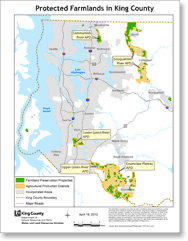
- Acres of farmland preserved through the Farmland Preservation Program: 15,400;
- There are approximately 500 miles of agricultural waterways in King County;
- More than 13,000 infestations of Class A and B noxious weeds are controlled in the county each year;
- King County commercially-grown farm products
- 2017 Local Food Initiative Indicators
King County farm programs
Farm King County
Find technical assistance for farms located in King County. Services are provided by a partnership including King County, King Conservation District, WSU Extension and Washington State Dept. of Agriculture.
King County Agriculture Program
Get help from King County's main group serving farmers.
Local Food Initiative
King County is working to establish a food pipeline between local growers and cities with hungry, healthy residents.
King County C-PACER Program
Property assessed financing mechanism to help agricultural and other commercial buildings get more efficient and resilient.
King County Agriculture Commission
Sign up for a newsletter to keep abreast of land use issues, policies, regulations and incentives affecting commercial agriculture in King County.

A program that supports the Livestock Management Ordinance, a King County ordinance intended to provide a buffer of safety to keep salmon-bearing streams free of pollution. Provides information and an application for cost-sharing of fencing, storage, and other potential expenses to help farmers embrace good stewardship practices.
Farm Pad Program
Find help with building a farm pad to protect livestock in King County floodplains.
Agricultural Drainage Assistance Program
Also known as the Fish & Ditch Program, this program provides technical and financial help to farmers working to maintain agricultural watercourses. The site provides an overview of the program, monitoring reports, maps of streams and ditches, and contact information.
Salmon Safe (external link)
Certifies fish-friendly farms for marketing or promotional purposes, to help influence the restoration of agricultural watersheds so that salmon can sustainably spawn and thrive.
Operational and environmental resources for farmers
Farmers market permits
Set up your account with King County Dept. of Health and apply for your permit.
Noxious weed control
Aggressive exotic plants degrade pastures, may poison livestock, and produce amazing volumes of long-lived seeds. To help control invasive weeds, King County offers a noxious weed list site to help with weed identification, a form to report noxious weed infestations, and information sheets on best methods to control noxious weeds -- and is available to answer your questions at the Noxious Weed line, 206-296-0290.
Farm management planning
Learn how to achieve agricultural benefits such as reduced livestock setbacks from streams, siting of agricultural buildings or access roads in stream and wetland buffers, and how to get exceptions to county clearing and grading permits while still protecting everyone's environment.
Manure management
Provides help on handling manure to avoid contaminating lakes and streams.
WSDA Dairy Nutrient Management (external link)
Describes laws and guidelines governing dairy waste dispersal to ensure clean water, and provides a form to report manure spills and discharges.
Loop biosolids
Biosolids are the nutrient-rich, composted solids extracted during wastewater treatment. This page provides information about biosolids and the biosolids program, answers questions about quality control and safety, and provides case studies of biosolids use and chemical analysis for fertilizer applications in commercial agriculture.
Agriculture documents
Plans, studies and reports related to Agriculture in King County, Washington.
- Farmers Market Report
Identifies financial challenges facing farmers markets that impact their viability and proposes changes to help strengthen operations and facilitate farmer access to the markets. - FARMS Report - Future of Agriculture Realizing Meaningful Solutions
Report describes the findings of a study that determining what measures King County and other agencies should take to ensure the continued success of local agriculture. - 2015 King County Strategic Climate Action Plan
How King County seeks to reduce greenhouse gas emissions, adapt to projected climate change impacts, and embed mitigation and adaptation into county policy decisions. The plan incorporates agriculture-related goals and actions.
Farmland preservation
Farmland Preservation Program
Voluntary program to preserve farms through voter-approved purchase of development rights.
Current use taxation
Reduce taxes for agricultural land uses (current use taxation), for providing public benefits or for timber lands.
Transfer of Development Rights Program
A voluntary program enabling landowners to buy and sell residential development rights on private property to preserve public benefits in our rapidly growing region-- for example farms, forestlands, open space, regional trails and designated urban separator lands and habitat for threatened or endangered species. Owners benefit financially through the transfer of development rights to better locations while the public benefits through permanent preservation of critical lands.
Farm related resources
King County working resource lands
Look up forests and farms protected by King County as working resource lands. The natural lands site provides pictures, location maps and rules for public use.
Wetland topics
Information about wetlands, wetland plants and wildlife, development and mitigation rules, and educational programs from King County.
Flooding services and information
Services to help before, during and after floods including the King County Flood Warning System, flood buyouts and other programs, how to call in drainage complaints, and hydrologic data.
Related information
Related agencies
News and announcements
Sign up to Unincorporated News:
Sep. 12, 2022
External article, Canary Media
What exactly is ‘climate-smart agriculture’?